
If you are looking for a list of Italian expressions that Italians actually use to boost your confidence when talking Italian. This is the right place for you. In this article, we will break down 50 of the most common Italian expressions that you can use in your daily Italian conversation with your Italian friends.
Agreement & Affirmation Italian expressions
1. Va bene. (Okay. / All right.)
Literally, “It goes well.” This is the all-purpose confirmation. It can mean “okay,” “fine,” or “I agree to that plan.”
- Va bene, ci vediamo alle otto.
- Okay, see you at eight.
2. D’accordo. (Agreed. / Okay.)
Literally “Of accord.” This means “we are in agreement.” It is slightly more formal than va bene and implies that a consensus has been reached.
- Allora facciamo così? D’accordo.
- So let’s do it this way? Agreed.
3. Certo! (Of course!)
An enthusiastic and confident “yes.” It reassures the speaker that what they are asking is obvious or guaranteed.
- Posso usare il tuo telefono? Certo!
- Can I use your phone? Of course!
4. Come no! (Absolutely! / Of course!)
Literally “How no?” – a double negative that turns into a strong positive. It means “Why wouldn’t I?” or “Absolutely, yes!” It conveys warm, eager agreement.
- Mi aiuti con questo? Come no!
- Will you help me with this? Absolutely!
Wishes, Hopes & Regret Italian expressions
5. Magari! (I wish! / If only!)
Expresses a strong desire for something that is unlikely or impossible. The tone can be wistful (If only I could!) or sarcastic (Yeah, right!).
- Andiamo al mare domani? Magari! Ma devo lavorare.
- Shall we go to the beach tomorrow? I wish! But I have to work.
6. Che bello! (How nice!)
Used to express genuine appreciation for something beautiful, pleasant, or good news. It’s a general exclamation of delight.
- Ho preso 30 all’esame! – Che bello!
- I got an A on the exam! – How nice!
7. Che peccato! (What a pity!)
Expresses disappointment about a missed opportunity or a bad outcome. It’s a polite way to show sympathy.
- La festa è stata cancellata. – Che peccato!
- The party was canceled. – What a pity!
Reactions & Surprise Italian expressions
8. Dai! (Come on!)
From the verb dare (to give). It is used to urge someone to do something, to express disbelief, or to encourage them (“Come on, you can do it!”).
- Dai, corri o faremo tardi!
- Come on, run or we’ll be late!
9. Ma dai! (No way! / Seriously?)
Literally “But come on!” This adds surprise to dai. It is the quintessential reaction to shocking or unexpected news, whether positive or negative.
- Marco si è sposato! – Ma dai! Non ci credo!
- Marco got married! – No way! I can’t believe it!
10. Non ci credo! (I can’t believe it!)
Expresses total astonishment. It is used when something is so surprising that it challenges your credibility.
- Ho vinto alla lotteria! – Non ci credo!
- I won the lottery! – I can’t believe it!
11. Che sorpresa! (What a surprise!)
A straightforward, neutral exclamation when something unexpected happens, usually pleasant.
- Che sorpresa! Non ti aspettavo qui.
- What a surprise! I didn’t expect you here.
Reluctance & Negation Italian expressions
12. Neanche per sogno! (Not a chance!)
Literally “Not even in a dream.” This is a very strong, emphatic refusal. It means “There is absolutely no possibility of that happening.”
- Mi presti la macchina? – Neanche per sogno!
- Will you lend me your car? – Not a chance!
13. Hai torto. (You’re wrong.)
Directly states that the other person’s information or opinion is incorrect. (From avere torto).
- La terra è piatta. – Hai torto, è rotonda.
- The Earth is flat. – You’re wrong, it’s round.
14. Non lo so. (I don’t know.)
The standard, neutral way to say “I don’t know” the specific information being asked for.
- Che ore sono? – Non lo so, non ho l’orologio.
- What time is it? – I don’t know, I don’t have a watch.
15. Boh! (No idea.)
This is the Italian shrug in word form. It implies total ignorance or indifference. It’s informal and means “Who knows? / I haven’t got a clue.”
- Dove sono le mie chiavi? – Boh!
- Where are my keys? – No idea!
16. Chi lo sa? (Who knows?)
A rhetorical question. It is less dismissive than Boh and suggests that the answer is mysterious or unknown to everyone.
- Pioverà domani? – Chi lo sa? Il tempo è imprevedibile.
- Will it rain tomorrow? – Who knows? The weather is unpredictable.
Consolation & Reassurance Italian expressions
17. Meno male! (Thank goodness!)
Expresses relief that a negative situation has been avoided or resolved. It literally translates to “less bad.”
- Ho trovato il portafoglio! – Meno male!
- I found my wallet! – Thank goodness!
18. Per fortuna. (Luckily.)
A calmer, more factual way to acknowledge that things turned out well due to luck.
- Ho preso l’ultimo treno. – Per fortuna.
- I caught the last train. – Luckily.
19. Non importa. (It doesn’t matter.)
States that something is irrelevant or not a priority. It can be neutral or slightly dismissive.
- Ho dimenticato il vino. – Non importa, ne abbiamo già.
- I forgot the wine. – It doesn’t matter, we already have some.
20. Fa niente. (Never mind.)
Used to tell someone to forget about a mistake or a topic. It means “It does nothing” – i.e., it has no consequence.
- Scusa, ho sbagliato. – Fa niente.
- Sorry, I made a mistake. – Never mind.
21. Non fa niente. (It’s okay. / No problem.)
A slightly more complete version of #20. It is the standard way to reassure someone after an apology (“It doesn’t do anything [to me]”).
- Mi dispiace per il ritardo. – Non fa niente.
- I’m sorry for being late. – It’s okay.
22. Lascia stare. (Forget it. / Leave it.)
From lasciare (to leave) and stare (to be). It is an imperative telling someone to stop touching a topic or physically touching an object.
- Proviamo a ripararlo? – Lascia stare, è rotto.
- Shall we try to fix it? – Forget it, it’s broken.
23. Tranquillo. (Relax. / Don’t worry.)
The masculine singular form of the adjective “calm.” Used as an exclamation to tell a man to chill out (use tranquilla for a woman).
- Ho paura dell’esame. – Tranquillo, andrà bene.
- I’m scared of the exam. – Relax, it’ll go fine.
24. Non ti preoccupare. (Don’t worry.)
The standard verbal way to tell someone not to stress. (Literally: “Don’t preoccupy yourself”).
- Ho perso il treno! – Non ti preoccupare, prendiamo il prossimo.
- I missed the train! – Don’t worry, we’ll take the next one.
25. Va tutto bene. (Everything’s fine.)
A blanket statement that the current situation is positive and under control.
- Come stai? – Va tutto bene, grazie.
- How are you? – Everything’s fine, thanks.
Politeness & Reassuring Others Italian expressions
26. Figurati! (Don’t mention it! / No worries!)
Used to brush off a “thank you.” It means “Don’t even picture it [as a problem].” It is very warm and informal.
- Grazie mille per l’aiuto! – Figurati!
- Thank you so much for your help! – Don’t mention it!
27. Ci mancherebbe! (Of course! / Not at all!)
A very polite response to “thank you” or a request. It literally means “It would be missing [for us not to do it],” implying that helping you is the bare minimum and a pleasure.
- Posso disturbarti? – Ci mancherebbe! Entra pure.
- May I bother you? – Not at all! Please come in.
Agreement, Correction & Emphasis Italian expressions
28. Hai ragione. (You’re right.)
Acknowledges that the other person’s point is correct. (From avere ragione – to have reason).
- Dovremmo partire prima. – Hai ragione, è meglio.
- We should leave earlier. – You’re right, it’s better.
29. In realtà… (Actually…)
Introduces a correction or a fact that contradicts what was just said. It softens the blow of disagreeing.
- È un bel film. – In realtà, non mi è piaciuto.
- It’s a good movie. – Actually, I didn’t like it.
30. Infatti. (In fact. / Exactly.)
Used to confirm what someone else just said. It means “That is precisely the truth.”
- Oggi fa molto caldo. – Infatti, ho acceso il condizionatore.
- It’s very hot today. – In fact, I turned on the AC.
31. Appunto. (Exactly.)
Very similar to infatti, but it is used more to bring a point home. It emphasizes that the speaker just made the same conclusion.
- Quindi dobbiamo aspettare. – Appunto, ecco il problema.
- So we have to wait. – Exactly, that’s the problem.
Like what you just learned and want more?
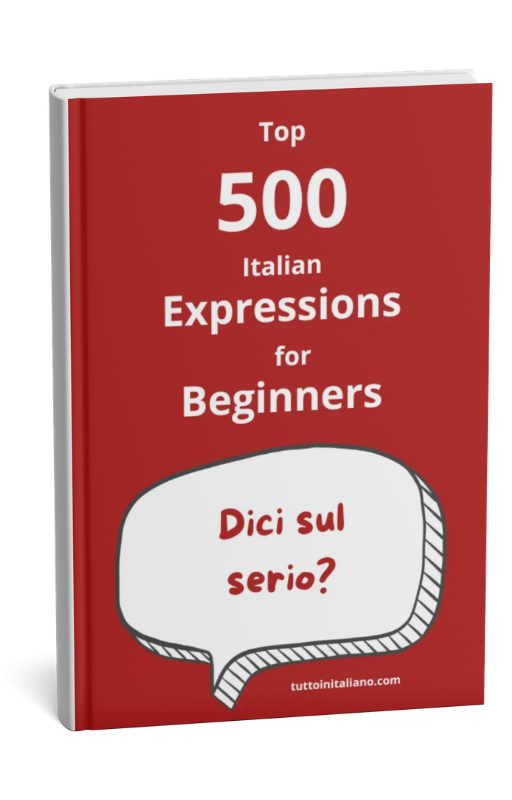
Get your first book of 500 Italian expressions for beginners to post your everyday Italian conversations
Hesitation & Filler Words (The “Thinking” Words)
32. Allora… (So… / Well…)
The ultimate Italian filler. Used to buy time, to change the subject, to start a story, or to signal “Well, let’s get going.”
- Allora… cosa facciamo stasera?
- So… what are we doing tonight?
33. Insomma… (Well… / Basically…)
Used when summarizing or when you can’t find the right words. It implies “in short” but can also express vague dissatisfaction.
- Com’è il film? – Insomma… non male, ma lungo.
- How’s the movie? – Well… not bad, but long.
34. Cioè… (I mean…)
Used to rephrase, clarify, or correct what you just said. It literally means “that is.”
- È simpatico, cioè, a volte è un po’ noioso.
- He’s nice, I mean, sometimes he’s a bit boring.
35. Comunque… (Anyway…)
Used to close a topic or return to the main point after a digression.
- Ho comprato il pane. Comunque, dovevamo parlare?
- I bought the bread. Anyway, did we need to talk?
Transitional & Informative Italian expressions
36. Per esempio… (For example…)
Standard way to introduce an example to clarify a point.
- Mi piacciono i frutti, per esempio, le mele e le banane.
- I like fruits, for example, apples and bananas.
37. A proposito… (By the way…)
Used to introduce a new topic that is vaguely connected to the current conversation. It literally means “About (the) purpose.”
- A proposito, hai sentito di Maria?
- By the way, have you heard about Maria?
38. E quindi? (So? / And then?)
Asks the other person to get to the point or explain the consequence of what they just said.
- Ho perso il lavoro… – E quindi? Cosa farai ora?
- I lost my job… – So? What will you do now?
39. Ci sentiamo! (Talk to you later!)
A common closing phrase on the phone. It literally means “We will hear each other.”
- Devo andare, ci sentiamo!
- I have to go, talk to you later!
Observation & Perception Italian expressions
40. Mi sa di sì. (I think so.)
Informal. Literally “It seems to me of yes.” It implies an educated guess.
- Viene anche Luca? – Mi sa di sì.
- Is Luca coming too? – I think so.
41. Mi sa di no. (I don’t think so.)
Informal. Literally “It seems to me of no.” The counterpart to the above.
- Piove ancora? – Mi sa di no, si è fermata.
- Is it still raining? – I don’t think so, it stopped.
Interactions & Commands Italian expressions
42. Vediamo. (Let’s see.)
Used when checking something physically or mentally. It buys time while you think.
- Dov’è il ristorante? – Vediamo… è qui vicino.
- Where’s the restaurant? – Let’s see… it’s nearby.
43. Aspetta. (Wait.)
The informal imperative asking someone to pause (use aspetti for formal).
- Aspetta! Ho dimenticato le chiavi.
- Wait! I forgot the keys.
44. Un attimo. (One moment.)
Literally “A moment.” A very polite request for a brief pause.
- Pronto? – Un attimo, te lo passo.
- Hello? – One moment, I’ll put you through.
45. Tutto a posto? (Everything okay?)
Literally “All in place?” Asks if the situation is orderly and fine.
- Tutto a posto? Hai bisogno di qualcosa?
- Everything okay? Do you need anything?
46. Come va? (How’s it going?)
The standard, casual way to ask “How are things?” (Literal: “How does it go?”).
- Ehi! Come va? – Bene, grazie.
- Hey! How’s it going? – Fine, thanks.
47. Che succede? (What’s happening?)
Asks about events occurring right now.
- Sento rumore! – Che succede?
- I hear noise! – What’s happening?
48. Che c’è? (What’s wrong? / What’s up?)
Literally “What is there?” Used to ask what is bothering someone or what is new.
- Hai il viso triste. Che c’è?
- You look sad. What’s wrong?
49. Dimmi. (Tell me. / Go ahead.)
The informal imperative of dire (to say). Used to invite someone to speak when they pick up the phone or hesitate.
- Pronto? – Dimmi pure.
- Hello? – Go ahead.
50. Senti… (Listen…)
The informal imperative of sentire (to hear). Used to get someone’s attention before making a point.
- Senti, ho un’idea.
- Listen, I have an idea.
Summary of Tonal Differences (The tricky ones)
- Va bene vs. D’accordo:
- Va bene is generic approval
- D’accordo is intellectual agreement.
- Non importa vs. Fa niente: both mean “never mind,” but fa niente is often used after apologies.
- Non importa means “it has no importance”;
- Fa niente means “it does nothing”
- Figurati vs. Ci mancherebbe:
- Figurati is a casual “no worries”;
- Ci mancherebbe is a more enthusiastic “it was my duty/pleasure.”
- Boh vs. Non lo so
- Non lo so is a fact (“I lack the knowledge”);
- Boh is an attitude (“I don’t care / I have absolutely no clue”).